What Every Medicare Advantage and D-SNP Plan Needs to Know About Value-Based Wound Care in 2026
If you're leading a Medicare Advantage or D-SNP plan right now, chronic wound care is probably not at the top of your strategic priority list. It should be.
The infrastructure that used to quietly absorb your most complex wound patients the mobile, fee-for-service wound care providers who managed them in the home has largely collapsed since January 1st, 2026. The financial exposure that collapse created is landing directly on your plan's total cost of care whether you've mapped it yet or not.
The plan leaders who are ahead of this problem share one thing in common: they stopped treating wound care as a line item and started treating it as a population risk.
The Market Shift Nobody Announced
CMS cut skin substitute reimbursements by approximately 90% effective January 1st, 2026 - a $19.6 billion reduction in Medicare spending. That single policy change was a direct strike at the business model that had sustained a significant portion of the mobile wound care industry.
Many of those providers built their entire revenue structure around high-cost biologic billing. When the reimbursement math collapsed, so did their operations. Some have already shut down. Others have reduced service areas, stopped accepting complex cases, or exited home-based care entirely.
Your wound population didn't shrink. Your vendor ecosystem just did.
What Chronic Wound Patients Actually Cost a Health Plan
Chronic wound patients represent approximately 2.5 to 5 percent of a typical Medicare population. Medicare spends roughly $28 billion annually on chronic wounds more than it spends on heart failure.
The True Cost Cascade
| Below-knee amputation (before therapy/prosthetics) | ~$70,000 |
|---|---|
| First-year cost of wound progressing to amputation | $110K–$382K |
| Annual Medicare chronic wound spend (total) | $28 Billion |
| Ulceration rate on remaining limb post-amputation | 20–30% |
Wound care costs scatter across claim types — home health, DME, podiatry, SNF, inpatient in ways that make the true population cost nearly invisible until it has already happened. By the time an amputation or a septic hospitalization shows up clearly in your data, the decisions that caused it were made months earlier.
Why Fee-For-Service Was Never Really Working
The fundamental flaw in fee-for-service wound care is structural. Providers get paid per visit. The longer a wound stays open, the more billing it generates. No individual provider is trying to slow healing but the system has zero financial incentive to accelerate it.
After 8 to 12 weeks without meaningful progress, a wound stops being a straightforward management problem and becomes a systemic failure cascade. Biofilm sets in. Chronic inflammation takes hold. Risk stops compounding linearly and starts compounding exponentially.
In a fee-for-service model, wound stagnation generates more revenue for the provider. In a value-based contract, it generates more cost for your plan.
What Value-Based Wound Care Actually Looks Like
A fully capitated wound care model works differently at every level — structurally, clinically, and financially. The provider takes on a fixed per-engaged-member-per-month fee covering all clinical costs, with no per-visit billing and no utilization spikes. The plan gets a predictable line item. The provider absorbs the clinical volatility.
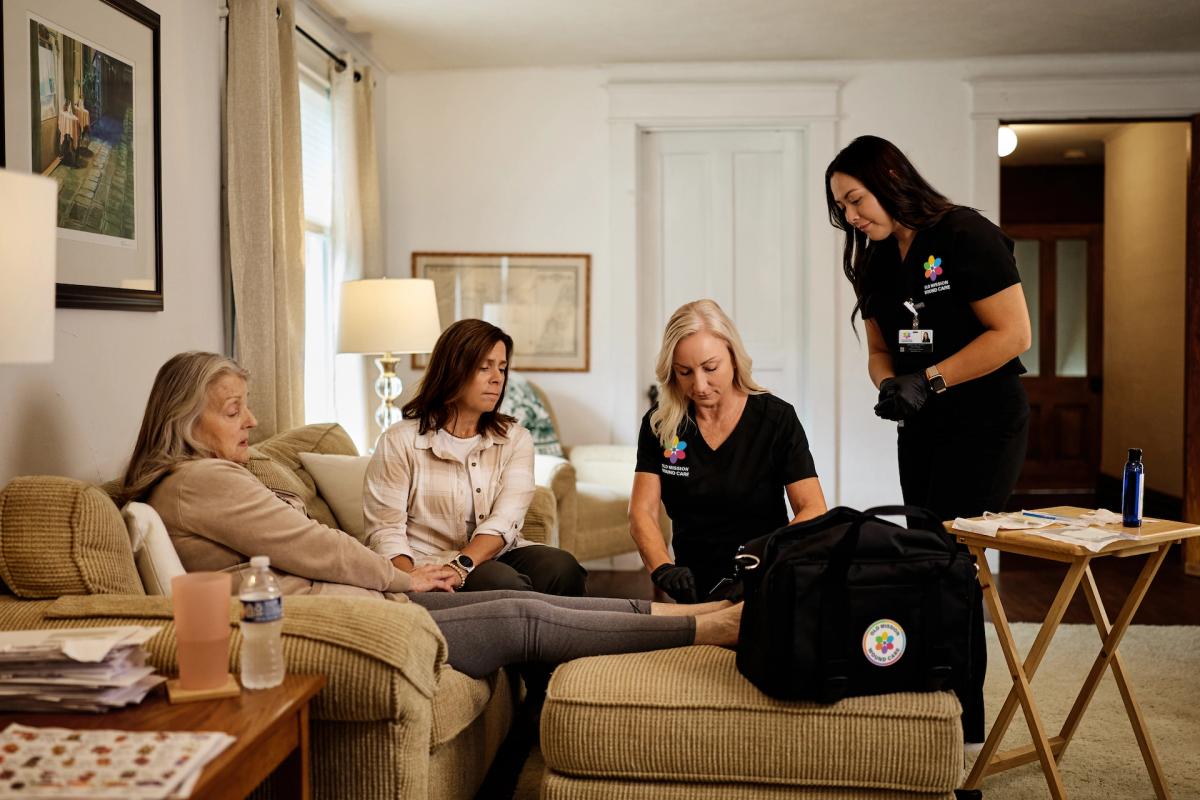
Clinically, care comes to the member. In-home, mobile wound care eliminates the access gap entirely. Physician-led assessment at every visit means early trajectory signals get caught and acted on before they become catastrophic events.
Financially, the incentives flip entirely. In a capitated model, the provider loses money when wounds stall. Ending the episode early is the financial win, not the loss.
At Old Mission Advanced Care, that alignment produces a 98.8% wound improvement rate compared to the 66% national average, and a 1.3% hospital readmission rate for wound patients.
A well-structured capitated wound care partner also closes HEDIS gaps while in the home diabetic retinopathy screenings, bone density assessments, SDOH documentation, nutritional optimization turning a wound care episode into a whole-person health touchpoint that supports your quality scores alongside your cost targets.
Three Questions Worth Asking Before Your Next Benchmark
If your plan carries downside risk on a Medicare population with meaningful diabetic or dual-eligible prevalence:
- Do you know what percentage of your members currently have an active chronic wound? If the answer requires pulling data from four different claim types to approximate — that gap is worth closing.
- What is your current wound care coverage in the markets where your highest-risk members live? Not in theory. In practice, post-January 1st, with the providers who are still operational.
- Does your current wound care strategy include a partner who takes financial accountability for outcomes — or are you still absorbing all of the downside risk while a fee-for-service provider bills per visit regardless of what happens to the patient?
Value-based wound care is not a future concept. It is operational, it is contracted, and it is producing measurable results in real Medicare populations right now.
If any of those three questions surfaced a gap worth exploring, I'd welcome 20 minutes to walk through what this model looks like for a population like yours with your actual member data, your market geography, and your value-based contract structure as the starting point. Reach Out
Share your thoughts and help others learn from your experience
Ready to Learn More?
Explore our comprehensive resource center for more insights on advanced wound care and healing.